Damned Nations by Samantha Nutt
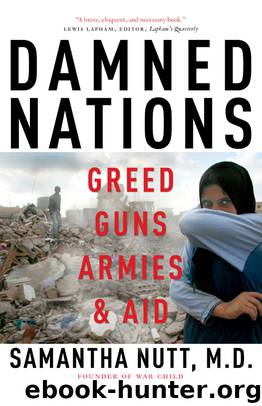
Author:Samantha Nutt [Nutt, Samantha]
Language: eng
Format: epub, azw3, mobi
ISBN: 978-0-7710-5147-0
Publisher: McClelland & Stewart
Published: 2011-10-24T16:00:00+00:00
Aid is an imperfect response to a violently imperfect world. That aid can be manipulated to prop up corrupt, oppressive regimes or become a form of political and cultural imperialism is not even in debate. But I reject the assertion that aid is the primary problem, or that impoverished and war-ravaged people would be a lot better off if we relied solely on the noblesse oblige of free market economics. I hope I have already provided compelling reasons, best exemplified by the widespread human rights abuses taking place in eastern Congo, as to why corporate-driven economic development in struggling nations is not the panacea some portray it to be. It is equally misguided to assume that aid stifles social unrest by producing “dependency” drones who won’t question their own oppression until the taps run dry. On the contrary, aid can be enormously beneficial in improving education and health, strengthening governance, and promoting social stability. Aid has the potential to be of tremendous value in tackling systemic injustices and inequities, and in curbing deaths from war, famine, and natural disasters. The challenge is in knowing which factors contribute to the various sides of this equation.
The origins of modern humanitarian action can be traced to Henry Dunant, the founder of the International Committee of the Red Cross. Horrified by the atrocities of war in Europe, he compelled European nations to sign the treaty of the First Geneva Convention in 1864 in order to recognize the neutrality of wounded combatants and the medics who assisted them. After World War I, additional aid groups appeared – notably Save the Children, founded in the United Kingdom in 1919 – and ushered in the current model of the independent and operational NGO. World War II provided the catalyst for the next phase: Oxfam was formed in 1942, CARE in 1945, and World Vision (a Christian aid group) in 1950. The United Nations and its agencies were also born during this time.
By the 1960s, international instruments relating to prisoners and civilians in war, refugees, and human rights were in place, and mechanisms for transporting relief goods and food aid became more efficient. When the Nigerian government went to war against the rebel state of Biafra in 1967, people in the West were shocked by the photos and stories of Biafran children starving to death. I was born a few years after this crisis, but I still remember my grandmother threatening to send my dinner to the “Children of Biafra” whenever I rejected her cooking as a child. My cousins and I had no idea where Biafra was, but assumed it had to be a fairly wretched place if they were being mailed Nanna’s soggy Brussels sprouts. (I only got away with saying “Perhaps that’s why they’re starving” once.)
As the governments of western countries struggle with declining public confidence and voter apathy (most pronounced among those under thirty years of age), NGOs appeal to their sense of effectuality and social responsibility. Participation in NGOs also offers a “safe”
Download
Damned Nations by Samantha Nutt.azw3
Damned Nations by Samantha Nutt.mobi
This site does not store any files on its server. We only index and link to content provided by other sites. Please contact the content providers to delete copyright contents if any and email us, we'll remove relevant links or contents immediately.
| Elections & Political Process | Ideologies & Doctrines |
| International & World Politics | Political Science |
| Public Affairs & Policy | Specific Topics |
| United States |
The Secret History by Donna Tartt(18963)
The Social Justice Warrior Handbook by Lisa De Pasquale(12171)
Thirteen Reasons Why by Jay Asher(8856)
This Is How You Lose Her by Junot Diaz(6843)
Weapons of Math Destruction by Cathy O'Neil(6223)
Zero to One by Peter Thiel(5741)
Beartown by Fredrik Backman(5687)
The Myth of the Strong Leader by Archie Brown(5471)
The Fire Next Time by James Baldwin(5392)
How Democracies Die by Steven Levitsky & Daniel Ziblatt(5181)
Promise Me, Dad by Joe Biden(5118)
Stone's Rules by Roger Stone(5058)
A Higher Loyalty: Truth, Lies, and Leadership by James Comey(4919)
100 Deadly Skills by Clint Emerson(4888)
Rise and Kill First by Ronen Bergman(4743)
Secrecy World by Jake Bernstein(4709)
The David Icke Guide to the Global Conspiracy (and how to end it) by David Icke(4664)
The Farm by Tom Rob Smith(4475)
The Doomsday Machine by Daniel Ellsberg(4460)
